Photo: Michael Hicks, CC BY 2.0, via Wikimedia Commons
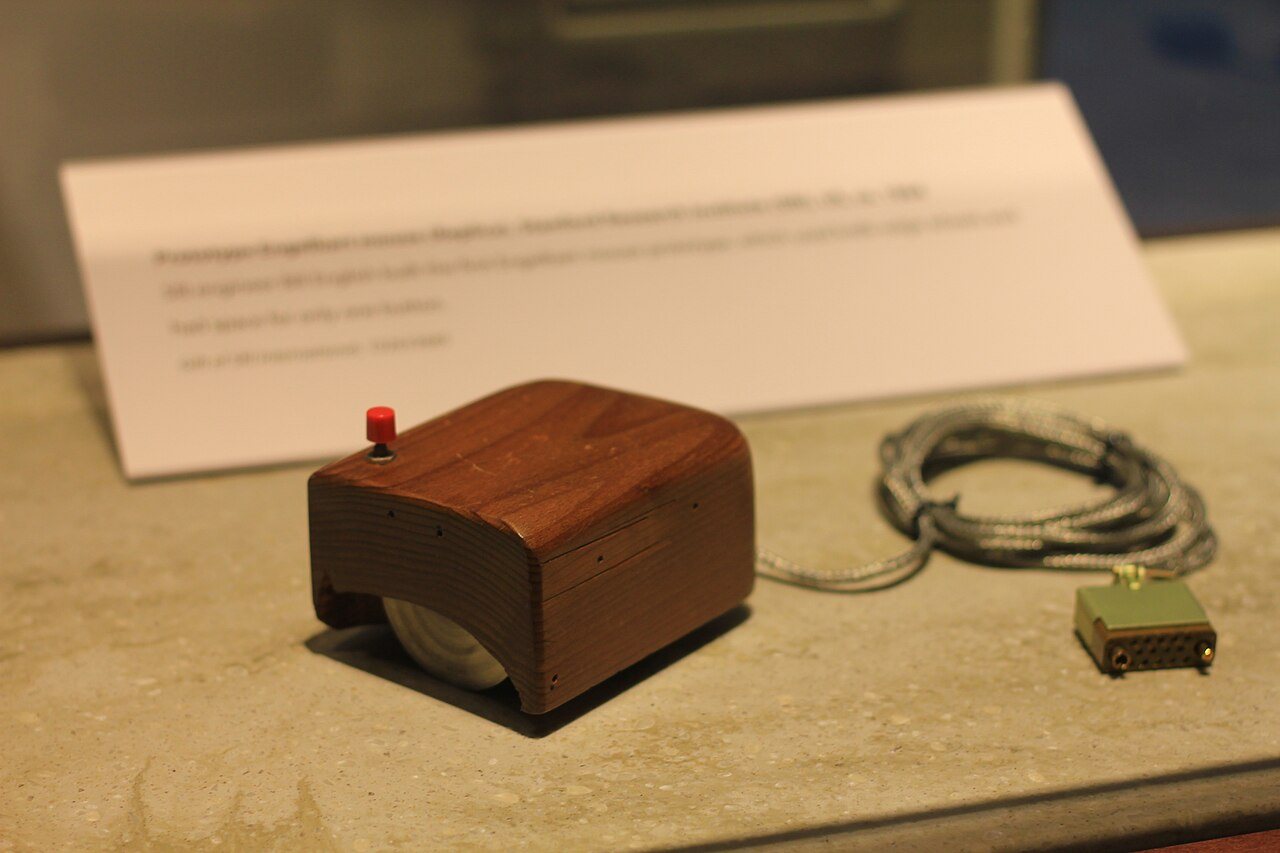
The first computer mouse is smaller than you would expect. It sits in a glass case at the Computer History Museum in Mountain View, California: a block of wood small enough to cup in one hand, with a single red button on top and a cable trailing out of it. It looks like something from a school woodshop.
On November 17, 1970, the United States Patent Office granted patent number 3,541,541 to Douglas Engelbart for that block of wood. The title on the paperwork was "X-Y Position Indicator for a Display System." Nobody at the patent office called it a mouse, though the engineers who built it already did.
What strikes me most, reading about it now, is how long the gap was between that patent and the moment ordinary people put a hand on one. More than a decade. By the time the mouse was everywhere, Engelbart's patent had already run out.
An engineer with a big idea and a small budget
Engelbart worked at the Stanford Research Institute, in Menlo Park, where he ran a lab called the Augmentation Research Center. His goal was broad and, for the early 1960s, a little odd: he wanted computers to help people think and work together, rather than simply crunch numbers in a back room.
For that, people needed a way to point at things on a screen. In the mid 1960s the options included light pens, joysticks and tracker balls. Engelbart sketched a different device, and in 1964 his chief engineer, Bill English, built it.
English carved the housing out of wood. Underneath were two metal wheels set at right angles to each other, one tracking movement left and right, the other up and down. Roll the box across the desk and the wheels turned, sending the position to the computer. That is the whole trick, and it is why the patent talks about an "X-Y position indicator."
How it got its name
The cord came out of the back of the box, like a tail. Somebody in the lab started calling it a mouse, and the name stuck. Engelbart said later that he could not remember who came up with it, which I find oddly charming for a man who otherwise thought very carefully about everything.
The team also ran tests. In a NASA-funded study, the lab compared the mouse against the light pen, the joystick and other pointing devices for selecting text on a screen. The mouse came out ahead, which gave the group a reason to keep working on it rather than treating it as a curiosity.
The demo that showed it to the world
The mouse had its big public moment almost two years before the patent arrived. On December 9, 1968, Engelbart sat on stage at a computer conference in San Francisco and gave a live, 90 minute demonstration of his lab's system, called NLS, short for oN-Line System.
With the mouse in one hand and a small chord keyboard under the other, he edited text on screen, clicked on links that jumped between documents, and worked on a file together with a colleague who appeared in a video window from the lab in Menlo Park, about 30 miles away. In 1968. People in computing still call it "the Mother of All Demos," and the nickname is not much of an exaggeration.
A lot of the audience left convinced they had seen the future. It just took the rest of the world a long time to catch up.
Germany had its own version
Engelbart was not entirely alone. In 1968, the German company Telefunken offered a ball-based pointing device called the Rollkugel ("rolling ball") for its TR 440 computer system. It worked more like the mice of the 1980s and 1990s, with a ball on the underside instead of two wheels. Few people outside a small circle of specialists ever used one, and it never had a stage moment like the San Francisco demo.
From Xerox to Apple to every desk
Bill English later moved to Xerox's Palo Alto Research Center, where the mouse got a rolling ball in place of the wheels. Xerox built it into the Alto, an experimental computer from 1973 that also had windows and icons on screen.
Apple, after visits to Xerox PARC, put a mouse on the Lisa in 1983 and on the first Macintosh in January 1984. Apple wanted a mouse that was cheap enough to sell to ordinary buyers, and its one-button design is the one that finally took the device out of laboratories. SRI had licensed the patent to Apple, reportedly for around $40,000. Engelbart himself never received royalties, and the patent expired in 1987, just as mice were becoming standard equipment.
He did get recognition, if not money. Engelbart received the Turing Award in 1997 and the National Medal of Technology in 2000. He died in 2013.
What to look for if you visit
If you are ever near Mountain View, the prototype is worth the trip. Look at the underside if the display lets you: the two wheels are the part that tells you this was a hand-built experiment, not a product. The ball mouse that replaced them, and the optical sensors that later replaced the ball, all do the same job those wheels were doing in 1964.
And the next time you click on a link, it is worth knowing that the man who patented the device under your hand also showed people clicking on links, live, in 1968. He was a good 25 years early on both.
Enjoyed this story?Get a new one every day on social.