Photo: Mathew Brady studio, public domain, via Wikimedia Commons (National Archives)
The main speaker at Gettysburg on November 19, 1863 was Edward Everett, former governor of Massachusetts, former president of Harvard, former secretary of state, and the most admired public speaker in the country. Everett stood on the platform at the new Soldiers' National Cemetery and talked for about two hours.
Abraham Lincoln got up after him and spoke for roughly two minutes, around 270 words depending on which version you count. Some people in the crowd reportedly had barely settled in by the time he sat back down.
That short speech is the one schoolchildren still memorize. Everett's oration, which was a perfectly good piece of work by the standards of the day, is read mostly by historians and the very patient.
A cemetery four months after the battle
The Battle of Gettysburg ran from July 1 to July 3, 1863. Combined casualties on both sides are usually put at around 50,000 killed, wounded, captured or missing, and the small Pennsylvania town was left with thousands of hastily buried Union soldiers in fields, gardens and along fence lines.
A local attorney, David Wills, took charge of a plan to give them proper graves on Cemetery Hill. Pennsylvania and the other Northern states with men in the ground agreed to share the costs, and reburials were still going on when the dedication took place in November. Everett was booked first, and the date was set around his schedule.
Lincoln's invitation came later. Wills wrote to him on November 2 asking the president, as chief executive, to set the grounds apart with "a few appropriate remarks." Reading that line now, I suspect the organizers expected something short and ceremonial, and they were half right.
The envelope story is almost certainly wrong
You may have heard that Lincoln scribbled the speech on the back of an envelope on the train from Washington. It is a lovely image, and historians have very little time for it.
Five handwritten copies of the address survive, known by the people who received or kept them: the Nicolay, Hay, Everett, Bancroft and Bliss copies. The earliest, the Nicolay copy, is partly written on Executive Mansion stationery, which points to Lincoln drafting at least part of it in Washington before he left. He arrived in Gettysburg on November 18, stayed the night at Wills's house, and seems to have worked on the text there too.
The copies do not match word for word. The best known difference is "under God," which appears in the later copies and in newspaper transcriptions of what he said on the day, but not in the two earliest drafts. My own guess (and it is only a guess) is that Lincoln added it on the platform, and then kept it when he wrote out the later versions.
What he actually said
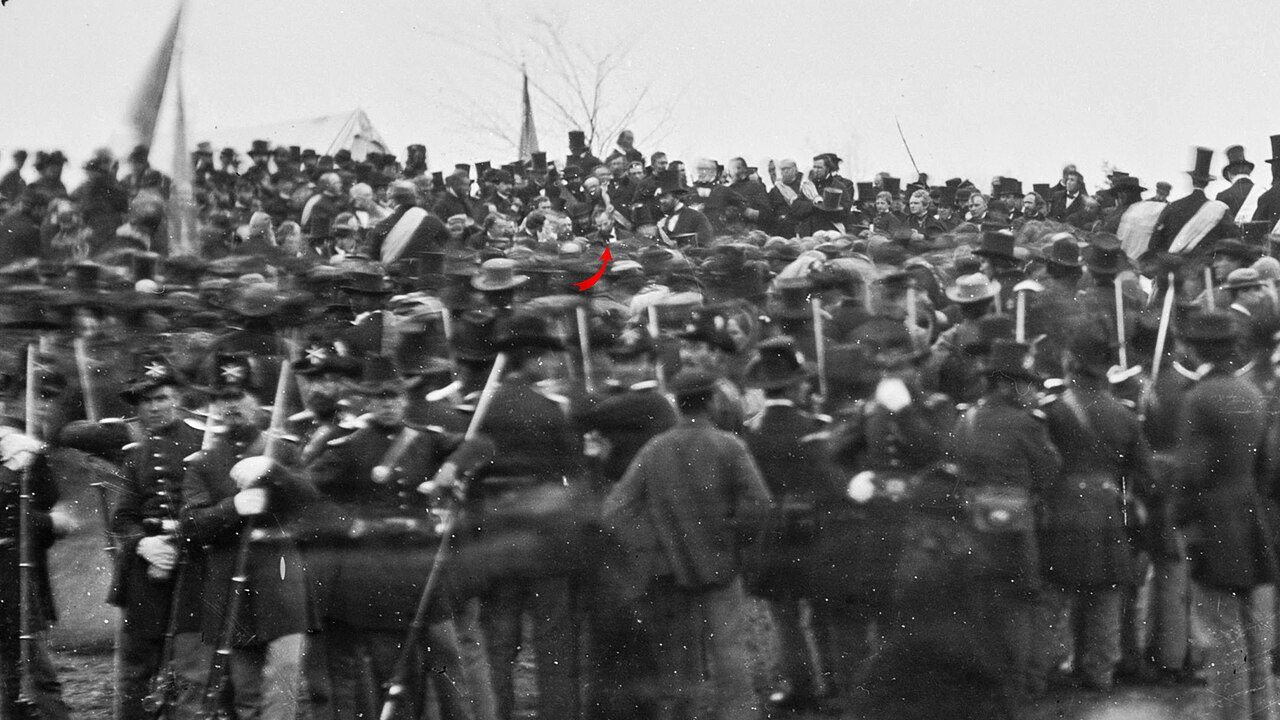
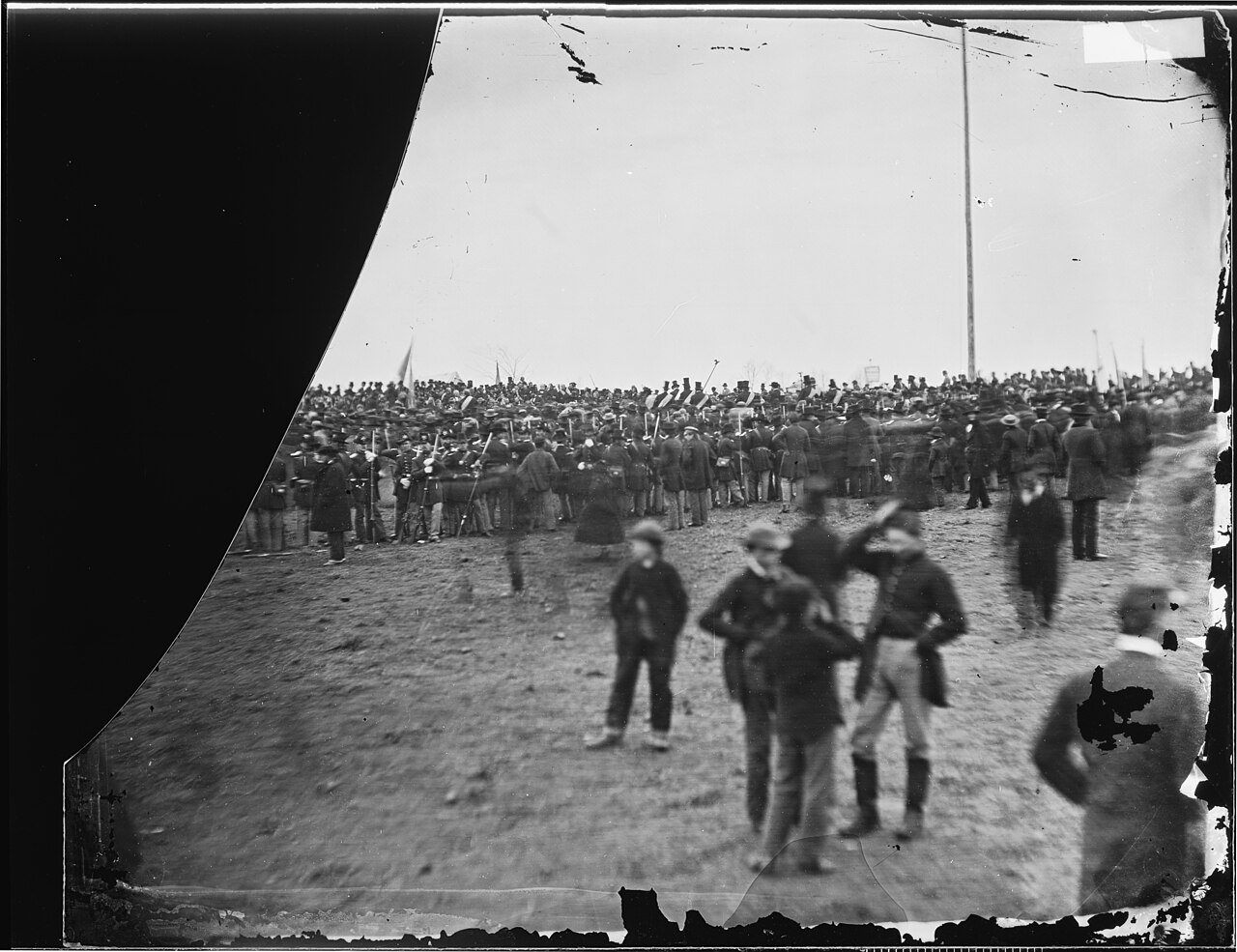
The crowd at the Gettysburg cemetery dedication, November 19, 1863. Photo: Mathew Brady studio, public domain, via Wikimedia Commons (National Archives)
The speech opens by counting back "four score and seven years," or 87 years, to 1776 and the Declaration of Independence. Lincoln anchored the nation in the Declaration's claim that all men are created equal, rather than in the Constitution of 1787, which had made room for slavery.
From there he moves quickly. The war is a test of whether a nation built on that idea can last. The living cannot really dedicate the ground, because the men who fought there already did. The job left to the audience is to finish the work, so that the country will have "a new birth of freedom" and government of, by and for the people will not disappear.
There is a famous bit of modesty in the middle: "The world will little note, nor long remember what we say here." He was wrong about that, as it turned out.
Reviews were split along party lines
Newspapers covered the speech the way they covered everything in 1863, which is to say according to their politics. Republican papers praised it. Some Democratic papers were openly scornful. The Harrisburg Patriot & Union dismissed Lincoln's "silly remarks" and hoped they would be forgotten.
That paper's successor, the Patriot-News, printed a formal retraction in November 2013, 150 years later. It is one of the better corrections in American journalism, and they had the good grace to make it a little funny.
The verdict that mattered came from Everett himself. The day after the ceremony he wrote to Lincoln that he wished he could flatter himself that he had come as near to the central idea of the occasion in two hours as Lincoln had in two minutes. Lincoln wrote back that he was glad to know the little he did say was not entirely a failure.
The only photograph, found almost a century later
No one filmed or recorded the speech, of course, and photographers working with slow glass plates mostly missed the moment Lincoln was speaking. For decades nobody believed a photograph of him at Gettysburg existed at all.
In 1952, Josephine Cobb, an archivist at the National Archives, was studying a Mathew Brady glass negative of the crowd and spotted a small, bareheaded figure near the speakers' stand. She identified him as Lincoln. The picture at the top of this page is a crop of that plate, and it is still the only widely accepted photograph of Lincoln at the dedication. Other identifications have been proposed since, but they remain argued over.
One more detail that rarely makes the textbooks: Lincoln felt unwell on the trip home, and doctors in Washington diagnosed a mild form of smallpox. He spent part of the following weeks recovering.
Visiting Gettysburg on the anniversary
The cemetery is part of Gettysburg National Military Park, run by the National Park Service, and you can walk the same rise where the speakers' platform stood. Every November 19, a Dedication Day ceremony is held at the cemetery, usually with a reading of the address.
If you go, look for the Lincoln Speech Memorial inside the cemetery, which carries the full text along with Wills's invitation. And if you cannot get to Pennsylvania, the Bliss copy, the only one Lincoln signed and dated, is kept at the White House. It takes about two minutes to read, roughly what it took the man who wrote it.
Enjoyed this story?Get a new one every day on social.