Photo: Victuallers, CC BY 4.0, via Wikimedia Commons
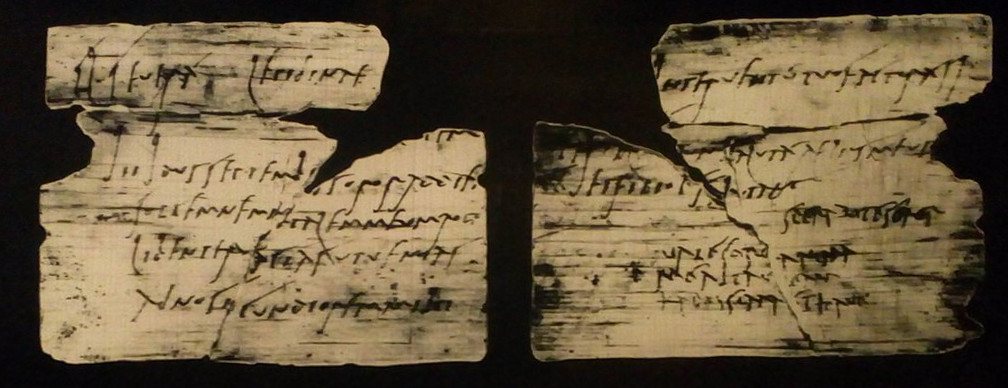
In 1973 the archaeologist Robin Birley was working through a drainage ditch at Vindolanda, a Roman fort a mile or so south of where Hadrian's Wall would later run, when he lifted out two thin slivers of wood stuck together. They looked like shavings. When they were prised apart there was writing inside, in ink, in a hand nobody had expected to survive the British weather for nineteen centuries.
Those slivers were the first of the Vindolanda tablets. Hundreds more have come out of the ground since, and between them they are the largest group of handwritten documents we have from Roman Britain. Most date from roughly AD 90 to 120, a few decades before the Wall went up.
Most of them are wonderfully ordinary. Inscriptions on stone tell you what Rome wanted remembered. These tell you what a garrison on the edge of the empire was actually worrying about that week.
Why the wood survived at all
Roman soldiers wrote on two kinds of tablet. One was a wooden frame filled with wax, scratched with a stylus and reused. The other, the kind found in such numbers at Vindolanda, was a leaf of wood about as thick as a postcard, usually birch or alder, written on with pen and ink and folded in half like a greeting card.
Wood and ink should rot. At Vindolanda the fort was rebuilt several times, and the builders tended to level the old buildings and lay fresh floors of clay and turf on top. That sealed the rubbish beneath in wet, airless layers where the bacteria that break things down could not do much. Leather shoes, textiles and the tablets came through in remarkable condition (the shoes are a story of their own).
The ink is another matter. On many tablets it had faded to nothing visible, and the texts were read with infrared photography, which picks up the carbon in the ink against the dark wood. The work of reading them was led for decades by Alan Bowman and David Thomas, and the main editions are online, free, through the Vindolanda Tablets Online project.
A birthday invitation from Claudia Severa
The tablet most people know is a letter from a woman called Claudia Severa to her friend Sulpicia Lepidina. Lepidina was the wife of Flavius Cerialis, prefect of the Ninth Cohort of Batavians stationed at Vindolanda around AD 100. Severa was married to Aelius Brocchus, who commanded another fort in the region.
The letter invites Lepidina to come on 11 September for Severa's birthday, and says her presence will make the day more pleasant. Most of it was written by a scribe. The last lines are in a different, shakier hand, which scholars take to be Severa's own: she tells Lepidina she will expect her, and signs off by calling her sister and her dearest soul.
That short postscript is usually described as among the earliest known writing in Latin by a woman. I find it hard to look at without feeling a little intrusive. It is a private note between friends, and it happens to be one of the best-known objects in the British Museum.
Socks, underpants and a shortage of beer
Plenty of the other tablets are about supplies, and they read like the kind of thing anyone stationed far from home writes. One letter to a soldier says that socks, sandals and two pairs of underpants have been sent. Rome had a reputation for hardiness, but the Tyne valley in winter evidently tested it.
Another, from a cavalry officer named Masclus, asks his commander for instructions for the next day and adds that his comrades have no beer, and could some be sent. It is one of my favourite documents from the ancient world, and I suspect not only mine.
There are accounts for food and cloth, records of pepper and chicken, and lists of who owed what. There are requests for leave. There is a complaint from a man who says he was beaten with rods, though how that ended we do not know.
What a fort strength report really shows
One of the most useful tablets for historians is a strength report for the First Cohort of Tungrians, a unit from what is now Belgium. On paper the cohort had more than 750 men. The report shows that fewer than 300 of them were actually at Vindolanda that day.
The rest were scattered. A large group was at Coria, modern Corbridge, and others were off in London or on detached duties. Of those present, a few dozen were listed as unfit, sick, wounded or suffering from inflammation of the eyes.
This matters because it corrects an easy assumption. A Roman auxiliary unit was not a tidy block of soldiers sitting in its fort. It was spread across the province doing errands, escort work and guard duty, and its commanders spent a lot of their time tracking where everyone had gone.
The wretched little Britons
One tablet gives a rare glimpse of how the soldiers saw the locals. It is a note, apparently an intelligence report, about British fighters: they had no armour, there were many cavalry, and the cavalry did not use swords. It refers to the Britons with the word Brittunculi, usually translated as "wretched little Britons".
It is a single word, and we should not hang too much on it. Still, it is a Roman garrison talking among themselves, and the tone is about what you would expect from an occupying army a long way from Rome.
Seeing the tablets today
The bulk of the tablets are held by the British Museum in London, where the Claudia Severa invitation is usually on display in the Roman Britain gallery. Some have been lent back to Vindolanda, and the site museum there shows them alongside the shoes, textiles and other finds from the same wet layers.
Vindolanda itself is still being excavated, and new tablets keep turning up most seasons. The Vindolanda Trust runs digs each summer with volunteers, and places are usually booked well ahead.
If you cannot get to Northumberland, the online editions are the next best thing. You can read Severa's invitation and Masclus's beer request in Latin and English in an afternoon, which is about the closest most of us will get to opening someone else's post from AD 100.
Enjoyed this story?Get a new one every day on social.