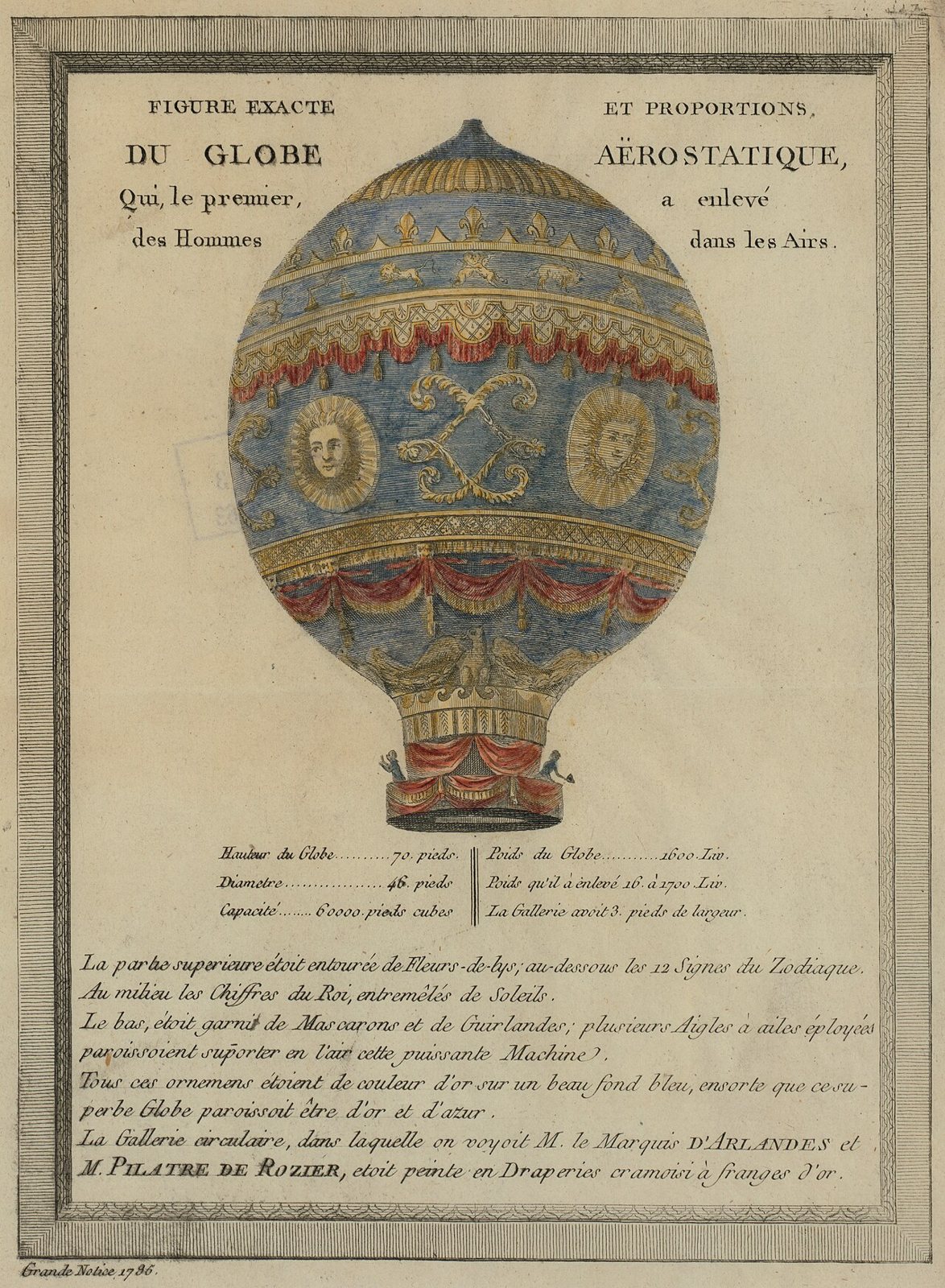
Print, 1786, unknown artist, public domain, via Wikimedia Commons
Early in the afternoon of November 21, 1783, in the garden of the Château de la Muette on the western edge of Paris, a balloon roughly 70 feet tall was held down by ropes while a fire of straw burned in an iron brazier underneath it. Two men stood in a narrow wicker gallery that ran around the balloon's open neck. One was Jean-François Pilâtre de Rozier, a young science teacher. The other was François Laurent, the Marquis d'Arlandes, an infantry officer.
When the ropes were let go, the balloon rose over the trees and drifted across the Seine. About 25 minutes later it came down among the windmills of the Butte-aux-Cailles, on the far side of the city, something like five and a half miles from where it started. It was the first free flight with people on board, untethered, and both of them walked away from it.
I find the dates around this flight almost more surprising than the flight itself. Five months earlier, nobody outside one paper-making town in the south of France had seen a balloon at all.
A paper mill in Annonay
The balloon came from the Montgolfier family, who ran a paper mill in Annonay, south of Lyon. Two of the brothers, Joseph-Michel and Jacques-Étienne, had been playing with the idea that the "smoke" from a fire could lift a bag. They did not yet understand that it was simply hot air, which is lighter than the cooler air around it. Joseph for a while believed some special gas came off burning straw and wool, which is why they were so fussy about their fuel.
On June 4, 1783, they gave a public demonstration in Annonay. An unmanned bag of cloth lined with paper went up, stayed aloft for about ten minutes and came down more than a mile away. Word reached Paris quickly, and so did Étienne, who was sent to repeat the trick for the Académie des Sciences and the court.
A sheep, a duck and a rooster at Versailles
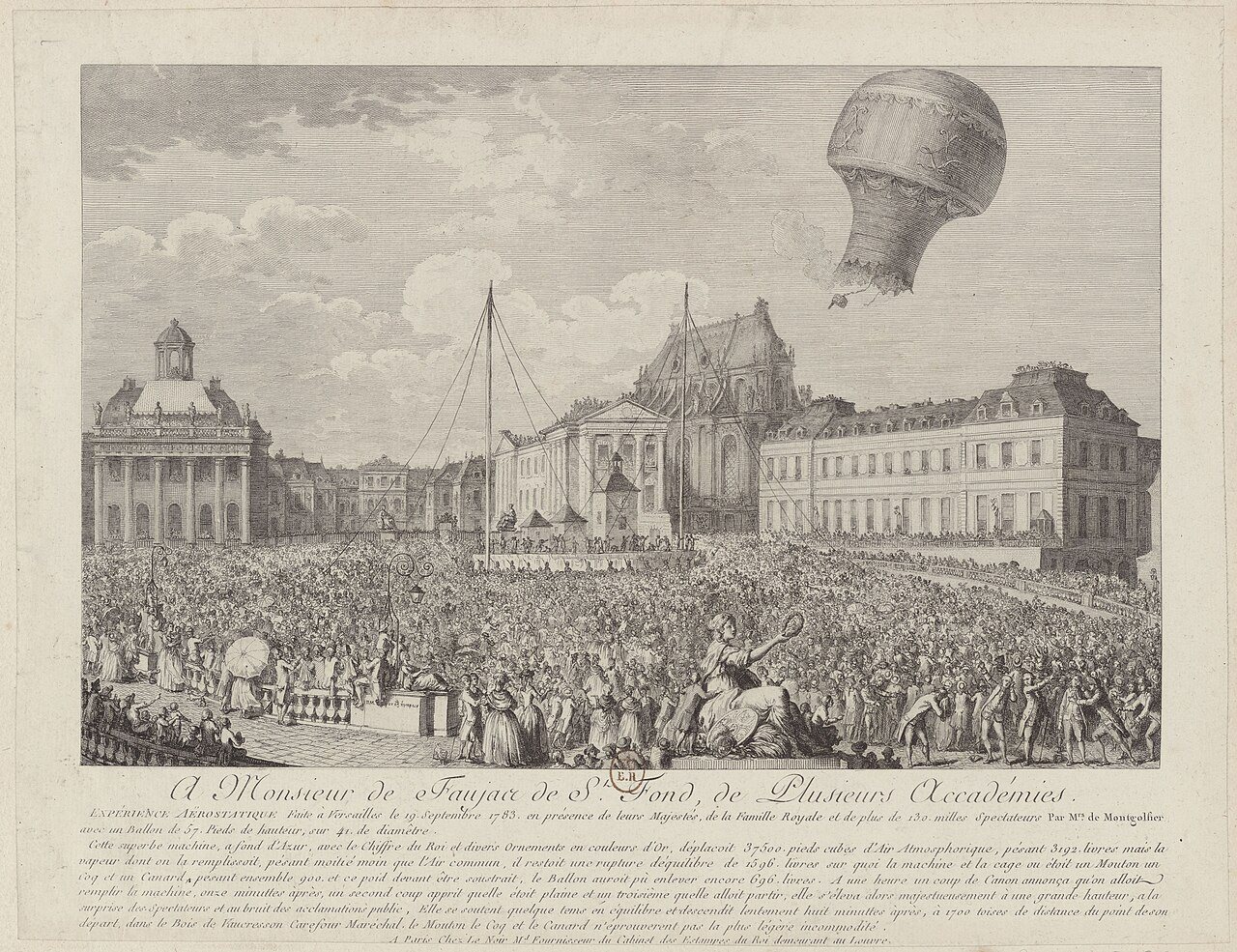
A crowd fills the forecourt at Versailles as the Montgolfier balloon rises on September 19, 1783. Engraving, 1783, public domain, via Wikimedia Commons
Nobody knew whether a living thing could survive at altitude, so the first passengers were animals. On September 19, 1783, at Versailles, a Montgolfier balloon carried a sheep, a duck and a rooster in a basket while Louis XVI and Marie Antoinette watched. The flight lasted about eight minutes. All three animals landed alive in a wood nearby. (The rooster is usually reported as slightly injured, most likely kicked by the sheep, which is the sort of detail I am always glad survived the archives.)
The king's first idea for a human flight was reportedly to send up two condemned prisoners, on the theory that they had less to lose. Pilâtre de Rozier lobbied hard against this, arguing that the honour of being first should not go to criminals, and d'Arlandes, who had connections at court, helped get permission. In October, Pilâtre made several ascents on a tethered balloon to learn how it behaved. On November 21, the ropes came off.
Twenty-five minutes over Paris
The balloon they flew was a showpiece. The surviving prints show it painted blue with gold decoration: fleurs-de-lys around the top, the signs of the zodiac, the king's monogram and suns around the middle, eagles near the base. It was made of cloth backed with paper, which is a good material for holding hot air and a terrible one to have near an open fire.
That was the main problem of the trip. To stay up, the crew had to keep feeding straw into the brazier with pitchforks. Sparks kept landing on the fabric. D'Arlandes later wrote an account of the flight, and the most memorable parts are about small holes burning through the envelope and him dabbing them out with a sponge he had dipped in water. He also admitted to spending some of the flight admiring the view while Pilâtre told him, more or less, to stop looking and start stoking.
Among the crowd watching from the ground was Benjamin Franklin, then in Paris as the American envoy. He signed the official record of the flight and wrote about it in letters home. There is a famous line credited to him from that year, answering someone who asked what use balloons were with "What good is a newborn baby?" It is a lovely line. It is also passed around in several versions, so treat the exact wording with some caution.
Ten days later, the hydrogen balloon
The Montgolfiers did not have the skies to themselves for long. On December 1, 1783, the physicist Jacques Charles and Nicolas-Louis Robert went up from the Tuileries Garden in a balloon filled with hydrogen, a gas that had to be made by pouring acid over iron filings. Their flight lasted about two hours and covered more than 20 miles. Hydrogen balloons could stay up far longer without a fire on board, and for a long stretch of the 19th century they were the serious choice.
For a while, France simply had balloon fever. Hairstyles, plates, fans and furniture were decorated with them. The two kinds even got their own names that are still used in French today: a hot-air balloon is a montgolfière, and a gas balloon is a charlière.
The first pilot was also the first casualty
Pilâtre de Rozier kept flying. In 1785 he tried to cross the English Channel from France in a balloon of his own design that combined a hydrogen cell with a hot-air cell below it. On June 15, 1785, shortly after takeoff near Boulogne, the balloon came down and he and his companion Pierre Romain were killed. They are generally counted as the first people to die in an air crash. His hybrid design, the Rozière, is still used today in a much safer form for long-distance record attempts.
D'Arlandes lived on until 1809. As far as I can tell, he never went up again.
Where to see the story today
The Château de la Muette, where the flight began, is still there. Since the late 1940s it has belonged to the organisation now called the OECD, which uses it as its headquarters, so the launch site of human flight is mostly full of economists. The Butte-aux-Cailles, where the balloon landed, is now a hilly neighbourhood in Paris's 13th arrondissement, and its windmills are long gone.
If you want to see the hardware side, the Musée de l'Air et de l'Espace at Le Bourget, north of Paris, has a section on early ballooning. And if you are anywhere near a hot-air balloon festival this winter, it is worth remembering that the basic trick has not changed since 1783. You heat the air inside a big bag and it goes up. The burners are just a lot more convenient than a man with a pitchfork and a wet sponge.
Enjoyed this story?Get a new one every day on social.