Photo: Anagoria, public domain, via Wikimedia Commons
In the summer of 1999, two men with a metal detector were working a wooded hilltop called the Mittelberg, near the town of Nebra in eastern Germany. They had no permit. What came out of the ground was a heavy bronze plate about 32 centimetres across, crusted green, with flecks of gold showing through the dirt. Alongside it were two bronze swords, two axes, a chisel and pieces of arm rings.
They dug the lot out with a hammer and a spade, which is the archaeological equivalent of opening a letter with a lawnmower. The pick left a gouge on the disc's edge that you can still see today. Then they sold it, and for nearly three years one of the most important prehistoric finds ever made in Germany moved quietly from dealer to dealer.
It is now usually called the Nebra sky disc, and it is the oldest known concrete depiction of the night sky anywhere in the world.
What the gold on the bronze actually shows
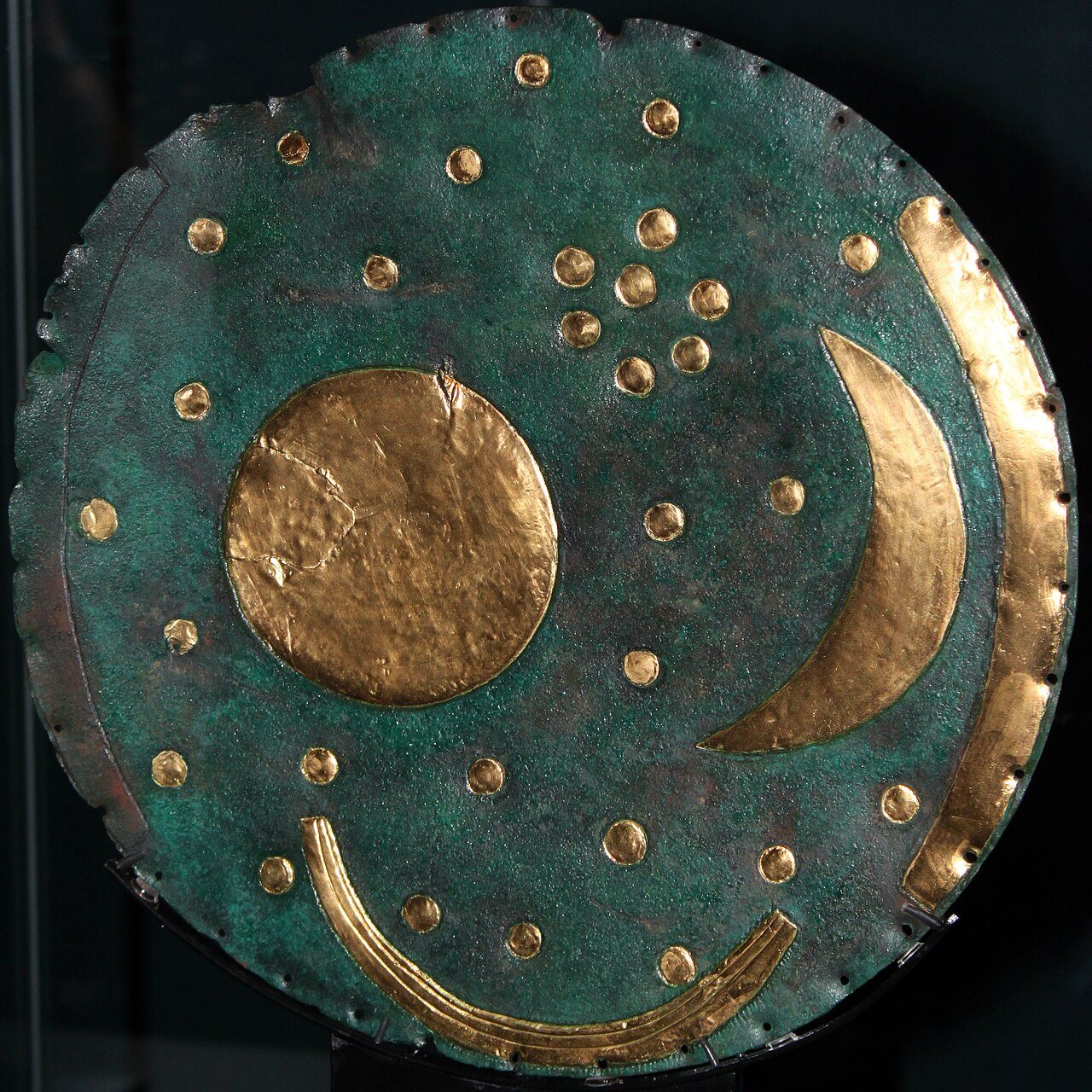
The disc weighs a little over two kilos. On its blue green face (the green is corrosion; polished new bronze would have looked very different) sit pieces of hammered gold sheet. There is a large circle, usually read as the sun or a full moon. There is a thick crescent moon. There are 32 small gold dots for stars, and seven of them are bunched together in a tight little rosette.
Most astronomers who have looked at that rosette take it to be the Pleiades, the star cluster that farming societies across the ancient world used as a seasonal marker. I find that reading convincing, mostly because nothing else in the sky looks like that to the naked eye.
Around the edge run two long gold arcs, one on each side, though only one survives. A third, shorter arc at the bottom, with fine parallel lines along it, is often called the sun boat. Ships carrying the sun across the sky turn up in Bronze Age art from Scandinavia to Egypt, so the label is a reasonable guess rather than a certainty.
The arcs that track the solstices
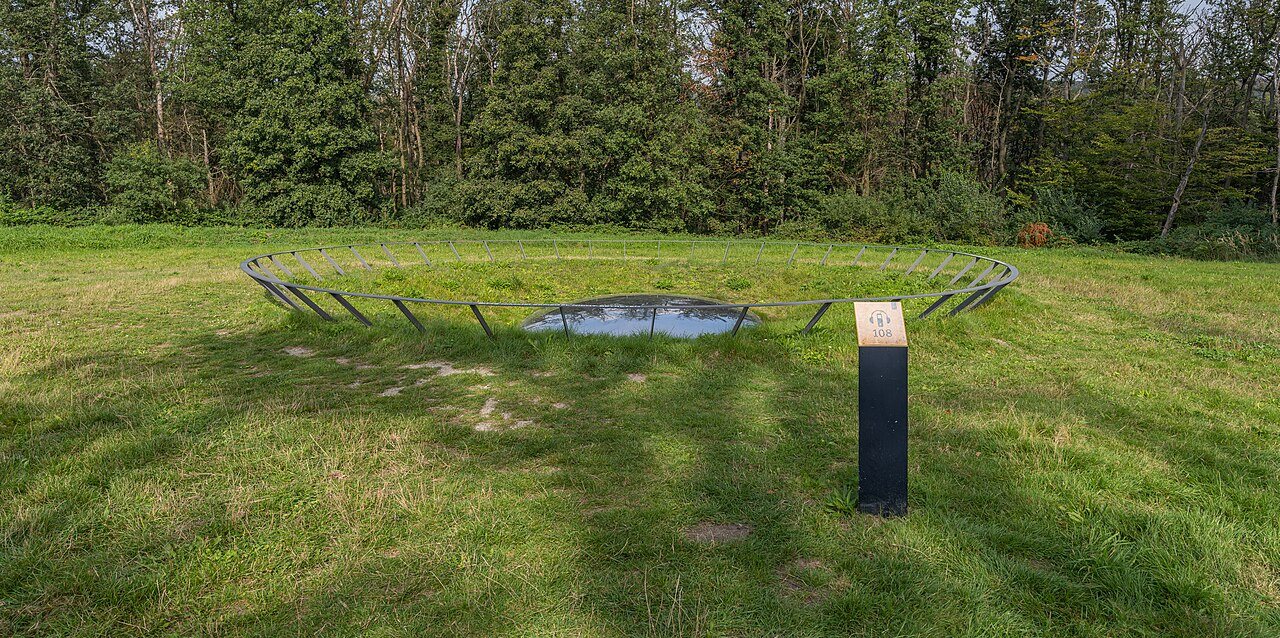
The fenced circle marking the find site of the Nebra sky disc on the Mittelberg hilltop. Photo: PantheraLeo1359531, CC BY 4.0, via Wikimedia Commons
The side arcs are where the disc stops looking like decoration. Each one spans about 82 degrees of the circle. From the Mittelberg, the point on the horizon where the sun sets moves back and forth over the year, and the distance between the midsummer and midwinter sunsets works out to roughly that same angle.
That is a local measurement. Shift the disc a few hundred kilometres north or south and the number no longer fits. The researchers in Halle argue that whoever made it was recording the sun's yearly path as seen from this part of Germany, and that the hilltop itself, which has a view toward the Brocken peak in the Harz mountains, was chosen for watching it.
Close study also showed the disc was not made in one go. The arcs were added after the first version, the boat after that, and at one point a star was moved to make room. Much later, someone punched a row of small holes around the rim, perhaps to fix it to something. Five or so phases of reworking, depending on how you count, which suggests people kept using it and kept changing their minds about what it should say.
A sting operation in a Basel hotel
The looters eventually sold the hoard on, and it changed hands again. By 2001 it was being offered around for a seven figure sum. In February 2002, Harald Meller, the state archaeologist of Saxony-Anhalt, agreed to meet the sellers at a hotel in Basel, Switzerland, posing as a buyer. Swiss police were waiting. The disc was seized on the spot.
The case went to court in Germany, and it is the reason we know the find spot at all. Under questioning, the original diggers led investigators back to the Mittelberg, where archaeologists confirmed the location from soil traces still clinging to the objects. Without that, the disc would have been a beautiful thing with no address, which for an archaeologist is not much better than a fake.
How old it is, and the argument about that
The objects found with the disc, particularly the swords, are the main evidence for its age. They point to burial around 1600 BC, in the Early Bronze Age, which would make the disc itself somewhat older. Analysis of the metals suggested the copper came from the eastern Alps, and studies of the gold and tin pointed toward Cornwall, in southwest England. That is a long supply chain for 3,600 years ago.
Not everyone accepted the dating. In 2020, two German archaeologists, Rupert Gebhard and Rüdiger Krause, published a paper arguing that the disc might not belong with the swords and could date to the Iron Age, perhaps a thousand years later. The Halle team answered quickly and firmly, pointing to the soil, the corrosion and the trial testimony that tied the hoard together. The Bronze Age date remains the mainstream view, and it is the one the museum uses, but the disagreement is worth knowing about.
Where to see it now
The original sits in the State Museum of Prehistory in Halle, in a darkened room that does it justice. It has been listed in UNESCO's Memory of the World register since 2013, and it has travelled only rarely, most memorably to the British Museum's Stonehenge exhibition in 2022, where it shared a room with objects from the same world.
If you go to Halle, give yourself an extra afternoon for the Mittelberg. There is a visitor centre near Nebra called the Arche Nebra and a viewing tower above the find site, and standing on that hill at sunset, looking toward the Brocken, makes the arcs on the disc a lot easier to understand. Opening times change with the seasons, so check before you make the trip. And if anyone ever offers you a green bronze plate with gold stars on it, call the police first.
Enjoyed this story?Get a new one every day on social.