Photo: Jonathan Mauer, CC BY-SA 4.0, via Wikimedia Commons
For most of the twentieth century, making a phone call meant a small workout for your index finger. You put it in the hole over the number, dragged the dial round to the metal stop, let go, and waited while it whirred back. Then you did it again. A number heavy with nines and zeros took a surprisingly long time.
On November 18, 1963, the Bell System started offering something different to customers in two towns outside Pittsburgh, Carnegie and Greensburg, Pennsylvania. The new phone had ten square buttons where the dial used to be. Bell called the service Touch-Tone, and it was the first time ordinary households could dial by pressing instead of turning.
It did not take over overnight. Rotary phones hung on in kitchens and hallways for decades (and they still have their fans). But the keypad that showed up in western Pennsylvania that week is, give or take two keys, the one you tap on your phone screen today.
Why the old dial was slow
A rotary dial works by interrupting the electric current on the line. Dial a 1 and the dial sends one quick break in the current as it spins back; dial a 5 and it sends five. A zero sends ten. The exchange at the other end counted those clicks, which is why the process is called pulse dialing.
It was clever and reliable, and it was slow by design, because the dial had to return at a steady pace for the counting to work. Engineers at Bell Telephone Laboratories had spent years looking for a faster way to send a number down a wire.
Two tones for every button
Their answer was to send sound instead of clicks. Each button on a Touch-Tone phone plays two tones at once: one from a low group of frequencies that marks the row, and one from a high group that marks the column. The rows use 697, 770, 852 and 941 hertz; the columns use 1209, 1336 and 1477 hertz. Press 5 and you get 770 and 1336 together.
The technical name is dual-tone multi-frequency signaling, usually shortened to DTMF, and the frequencies were picked carefully. They are not simple multiples of one another, and the pairs are unlikely to turn up in ordinary speech or music, so the exchange would not mistake someone humming down the line for a dialed digit. That was the theory, anyway, and it held up well enough that the scheme is still in use.
The point was speed. A machine at the exchange could recognize a pair of tones in a fraction of a second, no matter how fast the caller pressed. There was no waiting for a dial to spin home.
Who decided 1 goes at the top
The keypad you know puts 1, 2 and 3 on the top row. Calculators and adding machines do the opposite, with 7, 8 and 9 up top, and it is one of those small inconsistencies that nobody seems to have fixed in sixty years.
The phone layout was not an accident. Bell Labs had a group working on what it called human factors, the study of how people actually use machines, led by an industrial psychologist named John E. Karlin. His team tested different arrangements of buttons on volunteers, including circles, rows and various grids, measuring speed and mistakes. The three-by-three grid with 1 in the top left and 0 alone at the bottom came out of that testing. My hunch is that reading order did a lot of the work: people expect counting to start at the top left, the way a page does.
As far as I can tell, the team also fussed over things like how hard a button should be to press. It is a little humbling to realize that the feel of a keypad was ever somebody's research project.
The star, the pound sign and the hidden fourth column
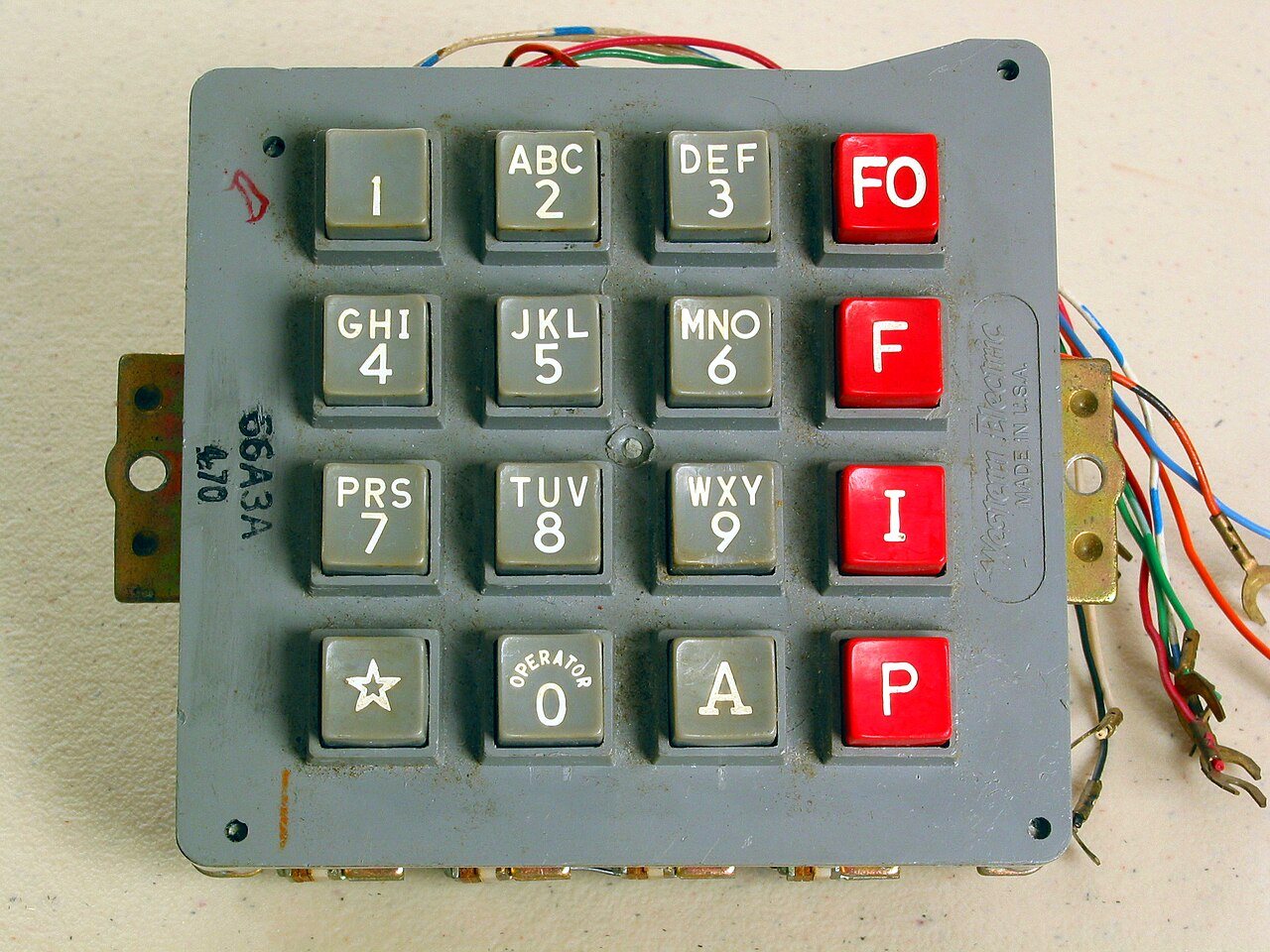
A Western Electric sixteen-key keypad with red keys marked FO, F, I and P in its fourth column. Photo: Lexlexlex, public domain, via Wikimedia Commons
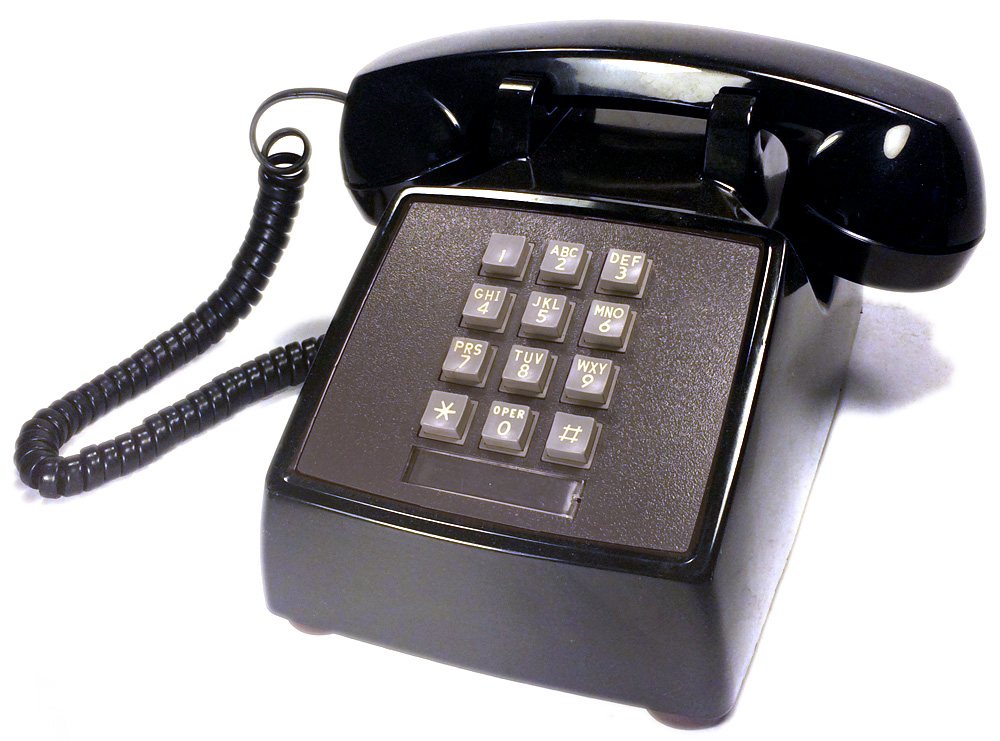
The first Touch-Tone desk sets, the Western Electric model 1500, had only ten buttons. The asterisk and the pound sign arrived a few years later, and the twelve-button model 2500, the phone in the photo at the top of this page, became the standard American desk telephone for a generation. Bell Labs people later called the pound key the "octothorpe," and the story of who coined that word is told several different ways. I would not bet money on any single version.
There is also a fourth column that almost nobody at home ever saw. DTMF includes an extra high frequency, 1633 hertz, which makes room for four more buttons, labeled A, B, C and D in the standard. The U.S. military's AUTOVON phone network used them to set call priority: Flash Override, Flash, Immediate and Priority. A general could, in effect, push his way to the front of the line. The red-keyed keypad above, built by Western Electric, shows those four keys as FO, F, I and P.
A slow switch from dial to buttons
Touch-Tone needed more than a new phone. Local exchanges had to be equipped to hear the tones, and that took years and a great deal of money. Phone companies charged a monthly premium for the service, and for a long time plenty of households decided the old dial was good enough. Rotary phones stayed on sale alongside the new ones for many years.
Which brings me to the thing I find most charming about the whole story. Because the tones travel down the line as sound, they work after the call connects, too. That is what made it possible, years later, to bank by phone, check voicemail, and press 1 for billing.
Listen for it next time you call a helpline
The Touch-Tone trademark has faded from everyday speech, but the tones themselves are still around. When you tap the keypad on a smartphone in the middle of a call, the phone generates the same paired frequencies that Bell engineers chose in the early 1960s, so the automated menu at the other end can understand you.
So the next time a recorded voice asks you to enter your account number followed by the pound key, you are using a system first sold to the public in two Pennsylvania towns on November 18, 1963. The beeps are the same ones, though the buttons now live on a sheet of glass instead of a heavy plastic desk set.
Enjoyed this story?Get a new one every day on social.