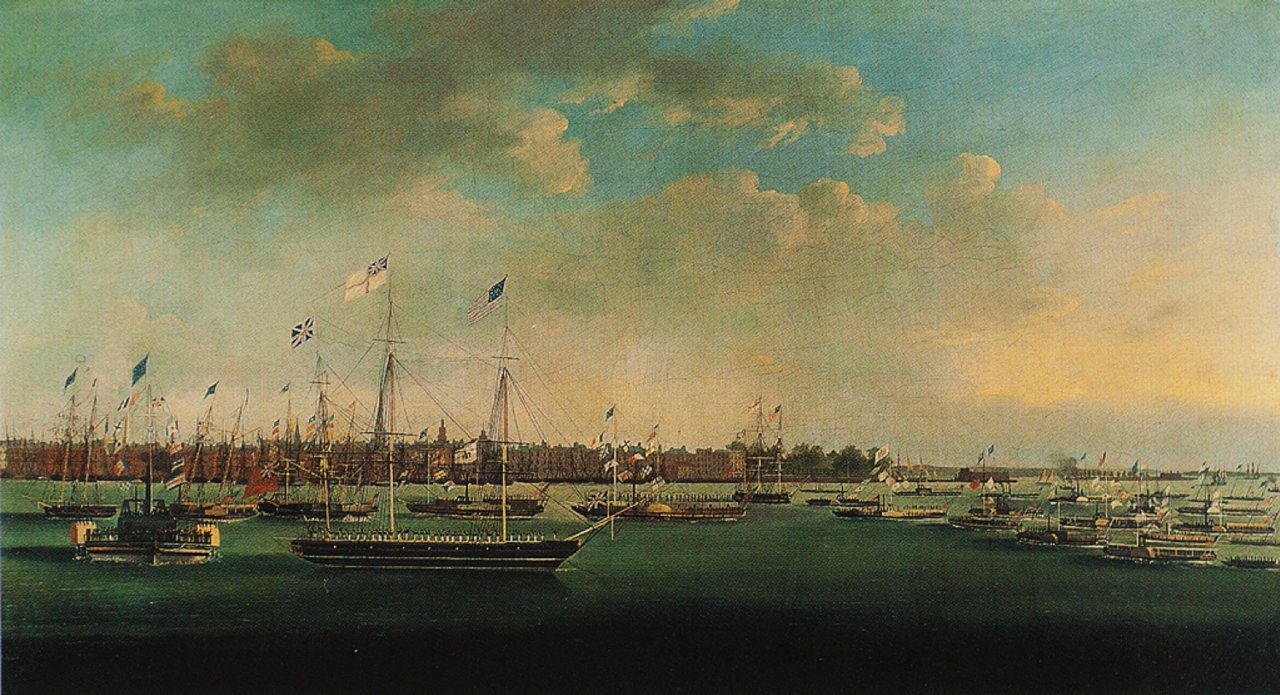
Painting: Anthony Imbert, public domain, via Wikimedia Commons
On the morning of 26 October 1825, a packet boat called the Seneca Chief pushed off from Buffalo with Governor DeWitt Clinton on board and two wooden kegs of Lake Erie water in its cargo. Somewhere near the dock, a cannon fired.
A few miles east, a second gun crew heard it and fired their own. Then a third. Guns had been set up along the 363 miles of new canal and down the Hudson River, each one close enough to hear the last, and the boom travelled across New York State faster than any horse could have carried a letter. By the usual account it reached New York City in about 81 minutes. Then the city fired back, and the signal ran all the way to Buffalo again.
It was the 1825 version of a push notification, and it was announcing the opening of the Erie Canal, 201 years ago today.
The ditch that Jefferson called madness
The idea was simple enough to fit in a sentence: dig a channel from the Hudson at Albany to Lake Erie at Buffalo, and let boats carry the farm produce of the interior straight to the port of New York. The hard part was everything else. There were forests, swamps and a climb of more than 500 feet between the two ends, and the United States had almost nobody trained as a civil engineer.
The federal government declined to pay for it. Thomas Jefferson, according to an account that has been repeated ever since, told one of the canal's backers in 1809 that the plan was "little short of madness." So New York State took the risk alone, borrowing roughly $7 million, a staggering sum for a state budget of the time. Critics called the project "Clinton's Ditch," and they did not mean it kindly.
Digging started at Rome, New York, on 4 July 1817. (Choosing Independence Day was not subtle, but politicians rarely are.)
Learning engineering with a shovel
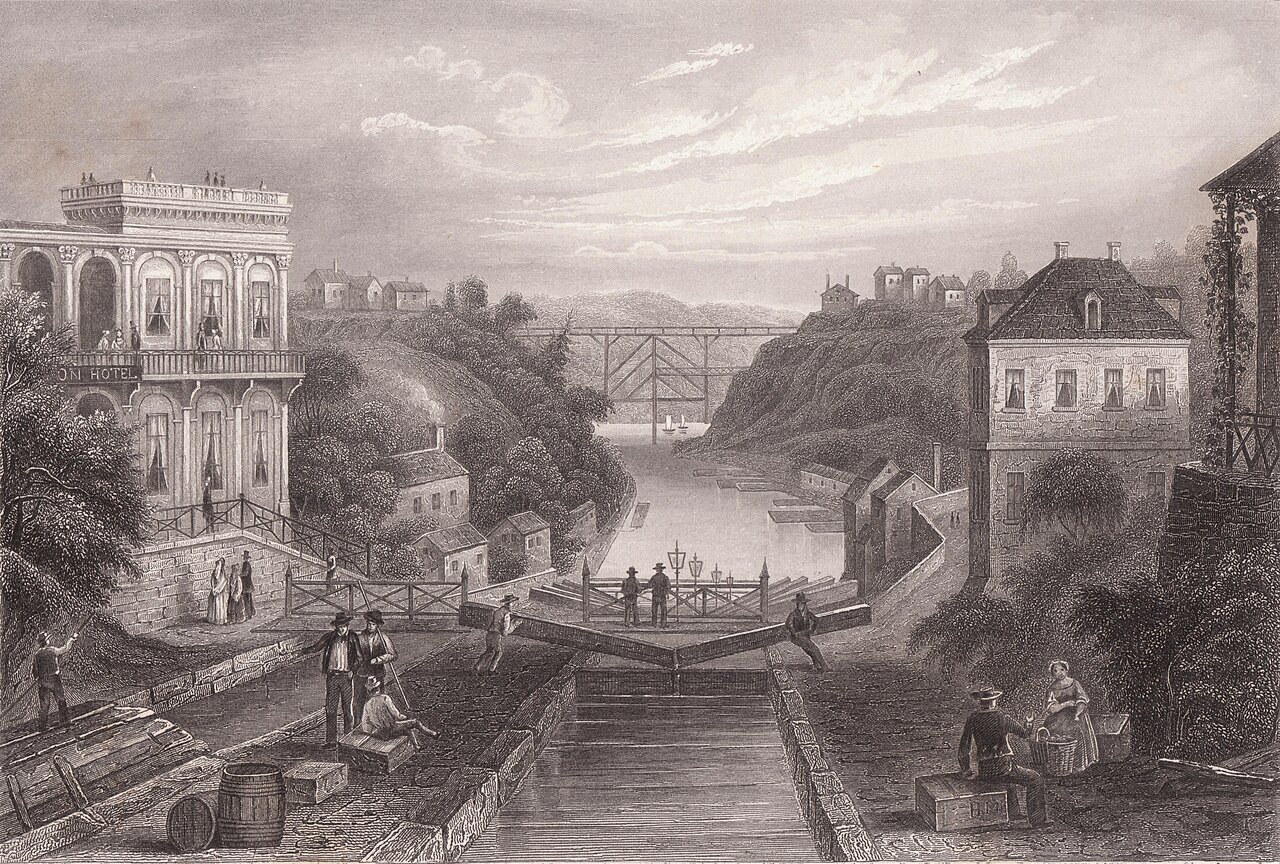
The locks at Lockport, New York, around 1855, with lock gates, a canal-side hotel and a bridge in the distance. Engraving published for Herrmann J. Meyer, public domain, via Wikimedia Commons
The men who ran the job were mostly surveyors and judges who learned as they went. Benjamin Wright and James Geddes laid out much of the route, and a young engineer named Canvass White found a local limestone near Chittenango that made cement able to set underwater, which solved the problem of building locks that would not leak apart.
The finished canal was 40 feet wide and only 4 feet deep, with 83 locks to raise and lower boats along the way. Crews of local farmers and immigrant labourers, many of them Irish, cleared trees, pulled stumps with oversized winches and dug by hand and with horse-drawn scrapers. Boats were pulled by mules and horses walking a towpath beside the water, which is why the low bridges across the canal became a running hazard for anyone standing on deck. A popular song from 1905, "Low Bridge, Everybody Down," is still how a lot of American schoolchildren first hear of the canal.
The toughest stretch came near the western end, where the canal had to climb the Niagara Escarpment. The answer at Lockport was a double staircase of five locks side by side, the "Flight of Five," cut into rock. It took years, and the town that grew up around it was named for the job.
Ten days to the sea
The Seneca Chief did not race. It travelled east through the new locks, stopping for speeches, dinners and cannon salutes in town after town, and reached New York on 4 November. Off Sandy Hook, Clinton lifted one of the kegs and poured Lake Erie into the Atlantic. The ceremony was billed as the "Wedding of the Waters," and the physician Samuel Latham Mitchill added bottles of water collected from rivers around the world, which seems a little much, but nobody had ever done this before and they were entitled to some theatre.
The harbor was packed with decorated ships and steamboats. Anthony Imbert's painting of the day, at the top of this page, gives a decent sense of the crowd on the water.
What the canal changed
The numbers settled the argument quickly. Shipping a ton of goods from Buffalo to New York had cost around $100 before the canal, by the commonly cited figure, and fell to roughly $10 after it. Tolls poured in so fast that the state paid off its construction debt within about a decade.
Grain, timber and salt moved east. People, furniture and manufactured goods moved west. Small villages along the route turned into cities almost overnight: Rochester grew so fast it is often called America's first boomtown, and Syracuse, Utica and Buffalo all grew up on canal traffic. New York City pulled ahead of Boston, Philadelphia and Baltimore and never looked back as the country's busiest port.
I would argue the canal also changed how Americans thought about public works. It proved that a state could borrow big money for infrastructure and get it back with interest, and a canal-building craze followed across the country, not all of it as wise.
From mule barges to kayaks
Success meant the original ditch was soon too small. New York enlarged it starting in 1836, and in 1918 most of it was replaced by the wider New York State Barge Canal, built for motorized boats. Railroads and later highways took away most of the freight, and long stretches of the old towpath were left to grass.
You can still use it, though. The canal is part of the New York State Canal System, and boaters, kayakers and canal-cruise passengers lock through every season it is open. The towpath has become the Erie Canalway Trail, which lets cyclists ride most of the way from Albany to Buffalo on flat ground. At Lockport you can see the modern locks working next to the remains of the old Flight of Five.
The bicentennial was celebrated last year, so the canal has just started its third century. If you find yourself in upstate New York this autumn, a walk along any part of the old towpath is worth an hour of your time. It is quiet now, which is the strangest part, given how loudly the whole thing began.
Enjoyed this story?Get a new one every day on social.