Photo: Joe Mabel, CC BY-SA 3.0, via Wikimedia Commons
On November 23, 1889, the drinkers at the Palais Royale Saloon in San Francisco found a new piece of furniture in the room. It was an oak cabinet with an Edison electric phonograph inside, a coin slot, and four rubber tubes hanging off it like a doctor's stethoscope. You put a nickel in, held a tube to your ear, and heard a song off a wax cylinder.
There was no loudspeaker. Each of the four tubes needed its own nickel, and everybody listening heard the same recording, because the machine held exactly one. By any modern standard it was a terrible jukebox, and it was also the first one.
The men behind it were Louis Glass, general manager of the Pacific Phonograph Company, and his business partner William S. Arnold. Glass had worked out that people who would never buy a phonograph would happily rent one for the length of a song, and he was right.
A nickel, a tube and a wax cylinder
The phonograph itself was barely a decade old in 1889. Edison had first shown his tinfoil machine in late 1877, and by the end of the 1880s the improved wax cylinder models were being pitched as office dictation machines. That use never really took off. Glass's coin attachment pointed the invention at something people actually wanted, which was music and comic recitations in a bar.
The figure usually quoted is that the Palais Royale machine took in more than $1,000 in its first six months. I can't vouch for the bookkeeping, but it was clearly enough to get attention, because coin phonographs spread quickly through the 1890s. Some cities got whole "phonograph parlors," rooms lined with machines where you walked along choosing a cylinder by its label.
Choosing your own song took another 20 years
The obvious weakness of the 1889 machine was that you could not pick what you heard. Someone else had already picked it. Inventors spent the next couple of decades on that problem. John Gabel's Automatic Entertainer, which came out around 1906, offered a choice of records and a big horn so a whole room could hear, though the sound was thin.
The real change came with electrical amplification in the late 1920s. Once a machine could drive a proper speaker, it stopped being a novelty for one listener and became something a whole bar could dance to. The repeal of Prohibition in 1933 helped too, since thousands of taverns opened at once and nearly all of them wanted music that did not need a band on the payroll.
Where the word "jukebox" came from
Nobody in the business wanted the name. Manufacturers called their products "automatic phonographs" or "coin-operated phonographs," which tells you something about how they saw themselves. The public said jukebox anyway.
The word comes from juke joints, the small roadhouses of the American South where people drank and danced. "Juke" is generally traced to a Gullah word meaning rowdy or disorderly. By the late 1930s the name had stuck, and the companies eventually gave up fighting it.
Bubble tubes and 100 selections
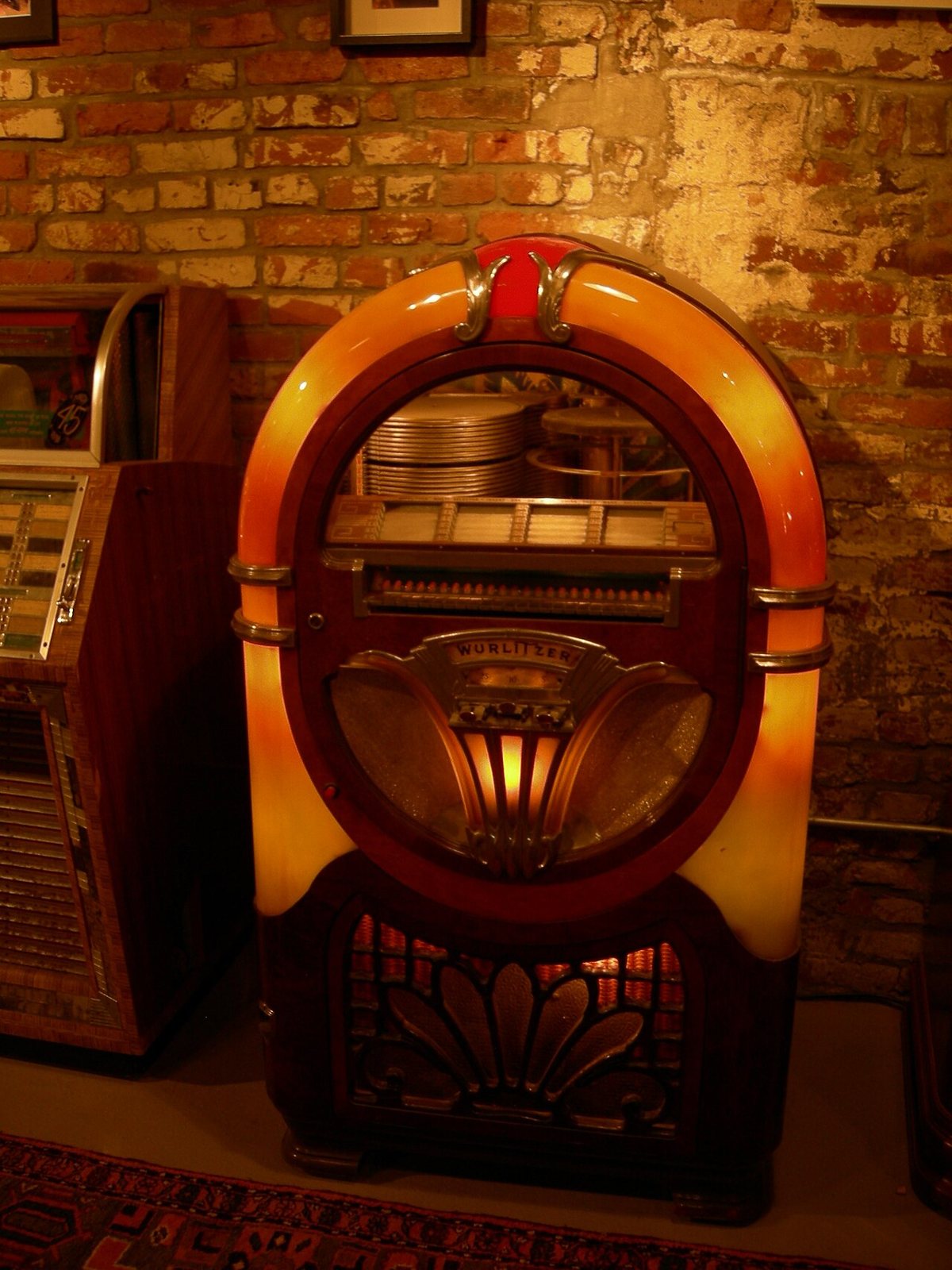
If you picture a jukebox, you probably picture something from the 1940s. The cover photo here is a Wurlitzer from that era, and the one most collectors talk about is the Wurlitzer 1015 of 1946, designed by Paul Fuller, with its arch of glowing color and bubble tubes running up the sides. Wurlitzer is usually credited with selling more than 56,000 of them, an enormous number for a machine that cost a bar owner real money.
Seeburg answered in 1948 with a machine that offered 100 selections, playing both sides of 50 records. Then RCA Victor introduced the seven-inch 45 rpm single in 1949, and Seeburg had a jukebox playing 45s on the market in 1950. The small record and the jukebox were made for each other. A hit single in the 1950s was, to a large degree, a song people paid to hear in diners and bars before they bought it.
(For what it's worth, my own soft spot is for the 78 rpm machines of the 1940s. They are heavier and a lot harder to keep running, which I suspect is part of the charm.)
Still in the corner of the bar
The jukebox never quite went away. Home stereos, then cassettes, then the internet were all supposed to finish it off. What happened instead is that the machine changed shape. Most of the jukeboxes in bars today are wall-mounted digital units that stream from a huge catalogue, and plenty of them let you pay and pick a song from your phone without walking over. That would have baffled Louis Glass. The basic deal, a coin for one song, would not.
If you are thinking about buying an old one
Vintage jukeboxes come up for sale more often than you might expect, and a few practical points will save you some pain. First, check what speed it plays. Most machines built before about 1950 play 78s, and most later ones play 45s, so a 1940s beauty will not play your 1960s singles.
Second, assume an old machine needs servicing. Many still have valve amplifiers and mechanical record changers with a lot of small, tired parts, and a "working" listing can mean anything. Ask whether it has been restored, by whom, and whether you can hear it play several records in a row.
Third, measure your doorway. The big 1940s cabinets are heavy and deeper than they look in photos, and plenty of buyers have found that out on the doorstep.
And if you only want to hear what all the fuss was about, look for a diner or bar near you with a working vintage machine. Put in a coin. It is a better way to mark the anniversary than reading about it.
Enjoyed this story?Get a new one every day on social.